


ISAE Animal Welfare Workshop in Patuakhali Science & Technology University, Bangladesh
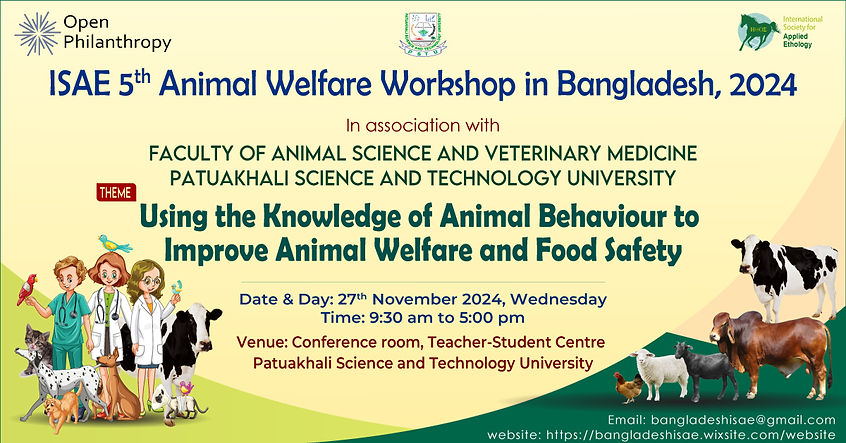
Date: Wednesday 27th November 2024
Venue: Conference room, Teacher-Student Center, Patuakhali Science & Technology University (Main Campus)
THEME:
"Using the knowledge of animal behaviour to improve animal welfare and food safety"
WORKSHOP SHEDULE
Background
The idea that animal welfare ought to be preserved and enhanced is becoming more and more popular worldwide. Animal and human welfare are closely related as human health depends on the productivity and well-being of animals for their food supply, and many human diseases are transmitted from animals. Our knowledge of why animals behave the way they do and how to best address the difficulties they encounter in both wild and captive settings is further enhanced by the scientific study of animal behaviour and welfare. The natural behaviour of animals may play a significant role in the comprehensive strategy for enhancing animal welfare in the days ahead, which will centre on climate change.
Animal welfare concept are becoming more valued than other quality features, and many consumers believe that products that are animal-friendly are mostly safer, healthier, tastier, hygienic, genuine, eco-friendly, and traditional in many ways. Consumers may pay higher price if the product arise from the farm that maintain higher standards of welfare. Customers will have more faith in the food chain players if welfare-friendly products are appropriately branded with clear information supplied by an internationally recognised, transparent, and traceable monitoring system. Government may pass laws that would create a minimum standard of welfare conditions that might meet the requirements of animals, improving the welfare of millions of farmed animals today and in the future. Taking accountability for the goods they purchase and supporting welfare-friendly companies are two ways citizens might accomplish this.
Although livestock production is essential to Bangladesh's socioeconomic structure and is required for the nation's progress, prosperity, and growth, the majority of Bangladeshis are still not aware that animal welfare does exist in a formal format. It contributes to the alleviation of poverty, the creation of jobs, the independance of women, improved household nutrition, the rise of export earnings, and the supply of fuel in the form of renewable energy and organic manure. Livestock contributes 1.80% of the nation's GDP (GDP, 2023–2024) and is expanding at a rate of 3.15%. Over 70% of people are thought to be involved in the livestock industry, either directly or indirectly. There are 3.90 million sheep, 27.0 million goats, 1.6 million buffaloes, and 25 million cattle among the large animals. Nonetheless, ducks and chickens make up the majority of the nation's 396 million (about) fowl (Department of Livestock Services: DLS, 2023–2024). Across the nation, the establishment of commercial poultry (layer and broiler), goat and sheep farms, duck farms, and cattle farms for dairy and beef production is becoming more and more common.
Four ISAE Animal Welfare Workshops have been held in Bangladesh since 2022; University of Rajshahi (June 20, 2022), Bangladesh Agricultural University (September 7, 2023), Sher-E-Bangla Agricultural University (September 9, 2023), and at the Sylhet Agricultural University (May 29, 2024). People are now paying more attention to the farm animal welfare, academician and researcher working on animal behaviour and welfare in association with the funding from the Bangladesh government and NGOs. Animal welfare is frequently discussed on radio and television in order to create healthy food animals and to reduce cruelty to animals. Prior to the 2022 ISAE meeting, government funding for research on animal behaviour and welfare had never been approved. The study of animal behaviour and welfare is gaining popularity among veterinary medicine and animal science graduates. The previous ISAE Animal Welfare Workshops have given participants the opportunity to become more knowledgeable about the situation of animal behaviour and welfare. The Animal Welfare Act of 2019 was recently passed by the Bangladeshi parliament, replacing the century-old Cruelty to Animals Act of 1920. Compared to other developing nations, Bangladesh lacks both credible empirical data on animal welfare and professional expertise in the field. The problems are interconnected: farmers are solely concerned with making money, veterinarians and other professionals are unaware of the suffering of animals, and the government is failing to enforce and oversee the fundamental laws and policies that support animal welfare.
Aim of the ISAE 5th Animal Welfare Workshop in Bangladesh, 2024
1. The aim of the ISAE animal welfare workshop in the Barisal region of Bangladesh is to raise awareness about the importance of animal behaviour and welfare. The workshop seeks to protect animals from suffering and promote animal welfare among key stakeholders, including local producers, farm and abattoir managers, livestock traders, livestock transporters, government employees from the Department of Livestock Services, veterinary students, graduates in animal science and related fields, academicians, and researchers. Participants will learn about animal behaviour as it pertains to animal husbandry, healthcare, and the prevention of cruelty towards animals.
2. To encourage community-based, sustainable and safe animal production through better management of animals to ensure food security and food safety to qualify for the export of livestock and thus to achieve a stronger economy.