


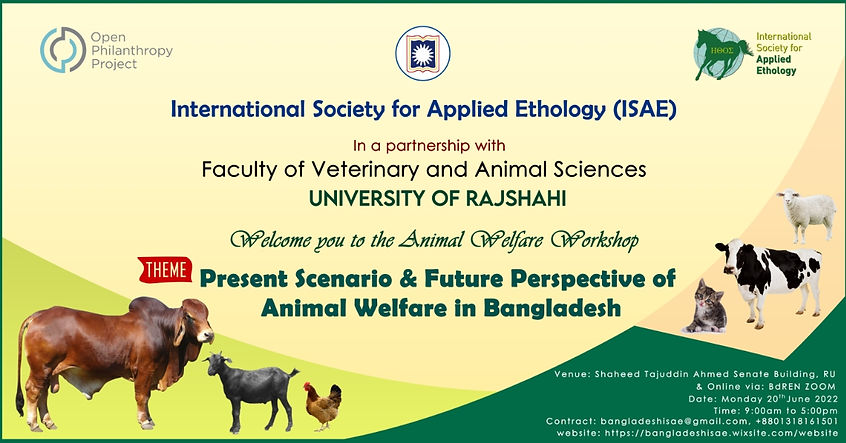
ISAE Animal Welfare Workshop in Bangladesh
Date: Monday 20th June 2022
Venue: Shahid Tajuddin Ahmad Senate Building, University of Rajshahi, Bangladesh.
&
Online via BdREN ZOOM
THEME:
"Present scenario and future perspective of animal welfare in Bangladesh"
WORKSHOP SHEDULE
Background
Bangladesh is an agricultural country where the livestock sector has been contributing 16.2% of the national gross domestic product. A total of 245.5 lakh cattle, 15.0 lakh buffalo, 36.8 lakh sheep, 266.0 lakh goats, and 3658.5 lakh poultry comprise the major livestock population of this country (Livestock Economy Report 2020-21), potentially contributing to combat the growing demand for milk, meat, and egg. Bangladesh has been enlisted as a middle-class income group country due to political stability in the last decade and continuous progress in the reduction of poverty and improvement in the related indexes of economy, though the country is densely populated. The economic affluence of middle-class people creates an opportunity to think about improved animal welfare, to ensure safe and quality meat, milk and eggs. Consequently, educated people have come forward in animal farming, transportation, and marketing as an entrepreneur in the name of organic and or free-range farming. Animal farming has now been also transforming towards industrialization.
However, there are distinct differences in the feeling of people linked to the welfare of animal depends on species. People are showing their empathy and raising money to take care of pet animals: homeless or street dogs and cats when needed. Some groups of students, NGO or community have been contributing to the awareness of dog and cat welfare, even though there are some reports on electronic media showing concerns of people for the prevention of wild animal trafficking and welfare. On the other hand, attitudes and opinions of livestock stakeholders such as but not limited to livestock farmers, veterinary professionals, animal scientists, agricultural processors, transporters, researchers, animal health technicians, educational facilities and teachers, retailers, and government agencies, indicate that animal welfare issues are largely overlooked in individual and or industrial level. Even, it is noticeable that the environment in which farm animals and or livestock are kept and or transported may lead to negative emotional states associated with the development of chronic physiological and behavioral abnormalities that may compromise their health, welfare, and productivity. There seems to be a lack of awareness of the relevance of animal welfare among the stakeholders in Bangladesh. Most of these stakeholder activities are not well coordinated due to a lack of effective network between livestock stakeholders, insufficient legislation, and poor enforcement of existing legislation.
The proposed workshop intends to achieve following aim:
To introduce the International Society for Applied Ethology (ISAE) and its activities in Bangladesh in order to promote livestock / farm animal welfare activities in Bangladesh with an aim to create a strong network between livestock stakeholders in presence of high official and related focal persons of livestock stakeholders in Bangladesh
Expected outcomes of this workshop:
1. Familiarization of ISAE and its activities to the livestock stakeholders of Bangladesh.
2. Discussion on critical animal welfare issues from farming to slaughter, and their solutions focusing existing animal welfare policies and improvements.
3. Start the process towards a strong network of animal stakeholders for the collaborative and strengthening existing partnerships of local, regional, national, government and nongovernment organizations to foster animal welfare across countries